Flash Burnout by L.K. Madigan

Blake has a girlfriend (Shannon), and a friend who's a girl (Marissa). This doesn't seem like a problem, at least not to him ... and not at first. Marissa is his photography buddy. They are "Pretty and Gritty" as their teacher refers to them (she takes pretty pictures, he takes gritty ones). It's strictly platonic between them, it isn't even as if they are that close until Blake unknowingly takes a picture of Marissa's mom.

He thought he was photographing a homeless person, but when he shows the photo in class, Marissa's reaction is far from impersonal. Apparently her mom is a junkie, and that's why she lives with her grandmother. Marissa pumps Blake for information, and she rushes off to look for her.

Surprisingly enough, she finds her. Marissa's mom agrees to go into rehab, and move back in with her family. It seems like things are going pretty well, but things aren't usually that easy. Marissa starts taking crazy risks, like barrelling down a hill on a bike with 300 other crazy people!

Shannon starts thinking that maybe there's something going on between Blake and Marissa. She doesn't want to be jealous, but it seems like every time she turns around they are together. It's especially hard for Blake because he doesn't feel like he can tell Shannon about Marissa's personal problems. Is there a way for the three of them to coexist? Can Blake find a balance between the girl he loves and the girl who needs him?

This story is so full of perfect touches. Their family pet is the Dog Formerly Known as Prince, Blake revels in the "first laugh of the day," his brother Garrett refers to him as Studly, his brother has it bad for a school dj called Cappy, his mom says things like "he'll rue the day!" ... so many special things that cannot be included in a synopsis. The humor thoughout really makes this story shine. Her insight into the teenage male is astounding. Recommended for males, and anyone who appreciates a quirky, realistic tale. Madigan won the Morris YA Debut award for excellence in a first novel.
"Then I have a close-up of black pavement where someone scattered a bunch of white petals. It made me wonder if some girl was picking up the petals, saying 'He loves me ... he loves me not ...' or if some guy got stood up by a girl and was ripping up the flowers as he walked away.
My favorite shot is the one that's the most depressing: a woman, dressed all in black and gray, is passed out against the side of a dirty gray building. Even her pale arm looks dirty and gray, with a tattoo of a snake slithering down it. The only color in the shot is a streak of bright purple in her hair. Marissa grabs the photo and holds it closer to her face. She gasps, a ragged sound that breaks through the murmur of other people. 'That's my mom!'" (Madigan, 2009).
*Library Link*

If you liked this, check out:
The Mermaid's Mirror by L.K. Madigan
How to Say Goodbye in Robot by Natalie Standiford
Carter Finally Gets It by Brent Crawford

Madigan, L.K. (2009). Flash Burnout. Boston, MA: Houghton Mifflin.

Bone: The Complete Cartoon Epic in One Volume by Jeff Smith

Bone is a classic: fantastic for all ages, and even better the second time around. I hadn't read this in a while. It came across the library check-in counter, and it just had to come home with me. I read the majority of it waiting around or flying in between airports on a recent vacation. While having it all collected into one volume is handy, it is also VERY HEAVY. I do not recommend this as a travel size, to say the least. However, my temporary discomfort gave way to instant enjoyment as I turned every page. I've heard it referred to as "Lord of the Rings meets Dickens - but funnier," and I am inclined to agree.

The Bone cousins have been run out of Boneville after another one of Phoney's schemes goes awry. The three cousins - Phoney, Smiley, and Fone (pronounced "funny") - make their way through unfamiliar terrain until they are separated in the woods. Fone is lost. He thought he was following a trail of Phoney's cigars, but it turns out they belonged to a dragon (yes, a dragon!). He is chased by some rat creatures who apparently want to bake him into a quiche! Luckily, he runs into some nice kids (animals and insects), and they point him in the direction of Gran'ma Ben and Thorn (humans). This turns out to be fantastic advice for Fone. Little heart bubbles start erupting above his head the moment he sees Thorn.

Her kind heart compels her to offer him a place to stay for the night, and the two plan to ask Gran'ma Ben if he can stay longer. They win her over, and settle in for the winter. Fone plans to search for his cousins as soon as spring comes. All winter Fone pines over Thorn, writing her terrible love poems, searching for just the right words to express himself, but he never shows them to anyone.

When spring arrives, so do Smiley and Phoney who have been staying in town. Smiley arrived first, and Phoney ran into him there. Phoney's natural greed kicks in and he starts another "get rich quick" scheme to get as much out of the villagers as he can...which begins to reflect negatively on Gran'ma Ben's cow chasing abilities (you just have to read it). Meanwhile, Thorn is starting to have weird dreams about dragons and princesses and The Dreaming. The rat monsters are being seen more often around the village. Everyone is starting to get nervous, and Gran'ma Ben seems to know more than she's telling.

There is more to this graphic novel than meets the eye. Far from just a sweet comedic tale, this involves fantasy, adventure, life lessons, and great characters. To tell much more would be a disservice to readers, so I won't. Just pick it up today, and you won't be sorry. I read the entire 1332 page tome in less than 4 days. I recommend this for early readers, reluctant readers, graphic novel fans, boys, girls, grandmas, families, and classrooms.
Fone's attempt to illude the rat creatures on his flight through the forest.
*Library Link*

 If you liked this, check out:
Rose by Jeff Smith
The Stonekeeper (Amulet, Book 1) by Kazu Kibuishi
Fables: Deluxe Edition 1 by Willingham, Buckingham, and Medina

Smith, Jeff. (2004). Bone: The Complete Cartoon Epic in One Volume. Columbus, Ohio: Cartoon Books.

Wicked Girls by Stephanie Hemphill

The story of the girls of the Salem Witch Trials never fails to make a cold chill creep down my spine. The idea that mob mentality can decide life and death is a personal fear that I live with ... and yet these girls did it initially for attention, and subsequently because they were pressured by family and friends ... or so the version written by Hemphill alleges.

In this verse style account, each character tells their personal view of the happenings. From the first accusations, to the first arrests, to the first trials, to the first death ... you see the reactions and the decisions through the eyes of the girls. 

For those of you unfamiliar with this story, the first person accused of witchcraft is a black maid. It seems that her "home remedies" of fortune telling and herbal concoctions are suspect enough to make the story viable. Of course, the girls involved want to shift blame away from themselves. They tell everyone that she is the one who made them do it, she is the evil one. 

One witch accusation is enough to send the town into a tizzy of finger pointing and allegations. The girls involved are suddenly small town celebrities, children who want to bask in the attention. Another is accused, and another. The girls start to have fits, claiming the devil pinches them, the witches visit them in the night and hurt them. More girls suddenly fall sick to the witchcraft. Soon the whole town is caught up in the story.

To deny the accusation is impossible, for what proof is there outside of the girls' testimony? To stand up and ask for reason becomes taboo, as it calls into question the authority of the church (the leaders of which support these girls). From whispers behind closed doors, it soon becomes clear that the girls are not the only ones who stand to gain from this. 

Hemphill weaves a dangerous tale of morality and mob mentality. Lies spiral out of control, and soon snowball. Each girl's tale holds a touch of reality and validity that makes the history behind the tale even more chilling.

*Library Link*
"The spirit reminds us all: do not forget what happened here," (Hemphill pg. 406, 2010).
If you liked this, check out:
Your Own, Sylvia by Stephanie Hemphill
A Break With Charity by Ann Rinaldi
The Crucible by Arthur Miller

Hemphill, Stephanie. (2010). Wicked Girls: A Novel of the Salem Witch Trials. New York: Balzer + Bray.

Moon Over Manifest by Clare Vanderpool

It's always been just Abilene and Gideon, her dad. They ride the rails from city to city, Gideon takes on odd jobs, and they figure out a way to survive. This time, she's on her own. Gideon has sent her back to his hometown of Manifest, Kansas for the summer of 1936. Her only tie to the place is in the form of an old newspaper article in which she keeps Gideon's prized pocketwatch. Manifest is a place unlike any she has been before. She stays with Pastor Shady, who is only the interim pastor, and also the local saloon owner. In her room at Shady's, Abilene discovers a box of keepsakes and letters, one of which warns of "THE RATTLER". She meets Mrs. Hattie Mae, the author of the 1917 article she treasures, and learns that Hattie Mae still writes her daily column all these years later. She befriends Lettie and Ruthanne, cousins who join her in her quest for an adventure.

Practically her first day she's getting in to trouble. She misplaces her dad's watch, and finds it on the porch of the local "diviner," or fortune teller, but she gets so spooked she ends up breaking one of her pots and runs off. Returning the next day, she strikes a deal with Miss Sadie, owner and proprietor, to return and do odd jobs to pay off her debt. In exchange, Miss Sadie tells her the history of the objects she has found in her room - and slowly, the story of Ned and Jinx unfolds.

While Lettie and Ruthanne help her discover clues, they search for the identity of "THE RATTLER". Abilene slowly learns the history of Manifest, and its heritage as a mining town. She hears the stories of the large number of immigrants that lived there, and begins to see connections from the past to today. Ned is an orphan who was adopted by members of the town, Jinx is a wanderer who stops in Manifest and decides to stay a while. The two become fast friends, and are always in the middle of some mischief. Jinx is the consumate con artist, and even uses his powers for good now and then.

The story is told from multiple perspectives, and from two time periods (1917-18 and 1936). One perspective is Abilene's, one is told through Hattie Mae's column (both past and present), Miss Sadie tells the story of Ned and Jinx in the past, and one perspective comes from the box of letters and keepsakes Abilene has found. These threads are woven together to create a story that will stay with you long after you have run out of pages to read. It's no wonder this is the 2011 Newbery Award Winner, and I'm proud to say it was written by a woman from my hometown.
"It is not down on any map; true places never are," (Melville quoted in Vanderpool pg. 1, 2010).
*Library Link*

If you liked this, check out:
Bud, Not Buddy by Christopher Paul Curtis
Esperanza Rising by Pam Munoz Ryan
The Wonder of Charlie Anne by Kimberly Newton Fusco

Vanderpool, Clare. (2010). Moon Over Manifest. New York: Delacourt Press.

Freaks and Revelations by Davida Wills Hurwin

Two stories in 1970s America.

One has grown up with an abusive father, a passive mother, absent siblings. Brother Carl is shot by a bad guy. This neighborhood isn't safe. The white people have to look out for themselves, that's what mom and dad say. It was a nigger ...
Drinking in the basement with Carl after they catch the guy, drowning the pain of a new DIY tattoo, only 13 years old. It's nice hanging out with Carl, even if he gets too cool when his friends are around.


The other has grown up in a big family, surrounded by Grandma and Grandpa, laid back stylish dad, beautiful disciplined mother ... until the day when his brother Paul takes off and doesn't come back. Then they are moving out, and mom and dad are getting divorced. They have to go to Catholic school, and Mom becomes severe, disciplined, very religious. The only highlight is dance class on Saturdays, where the most beautiful guy in class kisses so soft.

One gets high on whatever is around, drinking and smoking are easier than dealing with what goes on inside. It's not like Mom and Dad ever do anything about it. The only thing that helps is punk. The punk scene, the music, the fashion, the violence, the anger, the people, the shows, the rebellion! Finally something to relate to, to express himself.

One can't belive it how everything is falling apart. Jason decides he knows what will bring everyone together: he will break down the walls of lies with his truth. He will come out to his family, and they will open up to each other ... only that isn't what happens. His father walks out, his mother locks the door behind him, and he is left to fend for himself at 14.

Doug is in a band, they're gonna be famous. They are going to feel something, do something, BE something! Some punk cuts his hair, but he doesn't care. He's gonna do a mohawk, start clubbing for real, MEET people .. like chicks, because Doug is no fag. He's 6'4" and 140 pounds of angry, ready to stand up to anyone and anything, violence is so punk rock.

Jason doesn't know what to do, or where to go. All he can remember is the perfection of Castro Street, how boys and men could hold hands in public, and be themselves. It seemed like the only place he could go. But once he's there, he doesn't know what to do. He finds a little alley, a nook he can call his own, and falls asleep. In the morning he starts to learn how to fend for himself, asking for change, eating someone's left overs, and he starts to hang with the other boys who are making a living working the streets.

Two boys who are lost, fending for themselves in a cruel world ... surrounded by bad influences and people looking to use them. Their families don't care, their friends don't seem to know what is good for them ... their lives are on a crash course. Where will they end up? Such a powerful (and true) story about prejudice and the dangers of passing on your hate to your children, your friends, your enemies.

"I never saw a kid that night;
I saw a creature, an enemy, taking something that belonged
to me. That's not an excuse, I know - there is no excuse
no good reason. It's not an apology either. Apologies
don't really help. The thing is done. I did it,"

(Hurwin pg. 3, 2009).
*Library Link*

If you liked this, check out:
A Time for Dancing by Davida Wills Hurwin
Almost Perfect by Brian Katcher
Love Drugged by James Klise
Debbie Harry Sings in French by Meagan Brothers

Hurwin, Davida Wills. (2009).  Freaks and Revelations. New York: Little, Brown and Company.

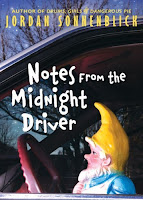
Notes From the Midnight Driver by Jordan Sonnenblick

So maybe he made some poor decisions...like drinking a fifth of whiskey, stealing his mom's car, and driving to confront his father for abandoning them to run off with his third-grade teacher. Okay, several very bad decisions ... which resulted in wrecking the car by hitting a lawn gnome, puking on a cop's shoes, a concussion, and alcohol poisoning. As you might have guessed, "Sarge" was less than thrilled. Alex is brought up on charges of drunk driving as a minor, and sentenced to community service at a local nursing home. His mother is a nurse at this particular nursing home, and assigns him one of their "challenging" residents, Mr. Lewis.

Mr. Lewis (Sol) is Jewish, and uses his considerable Yiddish skills to berrate Alex at every turn. In fact, one of his favorite phrases is "Gotcha!" Despite frequent protests, the judge is unwilling to reassign him to another patient. Sol even pulls one over on Alex's best friend Laurie (or as Sol calls her "Alex's wife"). As the days pass, and Alex begins to get to know Sol better, he finds they have something in common. Sol likes when Alex plays his guitar. Alex plays in the school jazz band, and is thrilled that they have something to share. A friendship grows between these unlikely two.

Meanwhile, Alex's parents are still at each other's throats ... and it looks like Alex's dad may be moving away. His mom keeps going on dates, and he just tries to keep his head down, hoping that he can get through it. For New Year's Eve, he and Laurie plan to throw a little party for the folks at the nursing home, and then have a sleepover. Sounds like a good plan, right? Of course, nothing goes quite as planned. Soon it becomes clear that things between Alex's parents are even more complicated than he thought ... and Sol found out about his mandatory community service, so he's mad too. All around a crummy night ...

With the help of two musical prodigies (the Cha-KINGS) from school, he begins to plan a benefit for Sol. He wants to make it up to him, and show that he really does care for the grouchy old man. After a lot of hard work, and a little awkwardness between he and Laurie, the big night comes. Of course, it wouldn't be an Alex evening without some unexpected developments. Sol is just full of surprises.

After an exhausing evening, especially for Sol, Alex has to face the facts that Sol is dying. Not today, but not very far in the future either. As the two grow closer, and learn more about one another, Alex tries to make Sol's one big dream come true. He learns a lot in the process, and causes a few goosebumps for readers. Touching, funny, awkward ... all the things a good teen novel should be - and a great book for boys.
"'Anyway, I read that book last year. Great, isn't it?'
'Who the hell are you? I've never seen you before in my life. Nurse. NURSE! Help! There's a thief in my room. I think he wants to -'
This was alarming. 'Mr. Lewis, wait! I'm just your ... um ... I'm Alex.'
'Help! Alex, the Um, is here to get me. NURSE!'
Claudelle came pounding through the doorway. 'Mr. Lewis, calm down. It's okay.' She gestured to me. 'This is just ...'
'Alex, the Um.' Then Mr. Lewis started laughing so hard I thought he might start choking again. 'Gotcha! Alex, the Um! Boy are you two gullible," (Sonnenblick pg. 56-57, 2006).
*Library Link*

If you liked this, check out:

Drums, Girls & Dangerous Pie by Jordan Sonnenblick
The Schwa was Here by Neal Schusterman
The Juvie Three by Gordon Korman

Sonnenblick, Jordan. (2006). Notes From the Midnight Driver. New York: Scholastic.

Stolen by Lucy Christopher

Lucy's pretty average. She lives with her parents in London, the picture of a city girl. She has a crush on her best friend's boyfriend, she argues with her parents now and again, and they are going on holiday to Vietnam.

There is a boy, she recognizes him from the flight from London, and now he is here with them in Bangkok. After arguing with her parents, she just wants some space. She sees you in the coffee shop, and you offered to pay for her drink...they wouldn't take her British coins. You even offered to add sugar for her...she was so flustered, she hesitated, but you reassured her. The two of you sat down together, and she wanted to explore the secrets in your deep blue eyes. You were older than she first thought, but she liked the attention. Besides, what could happen in an airport? You chatted, asking her about herself, putting her at ease...then, everything slowed down and sped up at the same time. Suddenly, she was walking, following you...to her gate? No, to the bathroom. Everything was fuzzy, floating, and she was changing into new clothes. You were giving her something to eat, chocolate? Time became muddled, where was she? Then the pain, and the heat, and the swaying of a car.

Stolen. She had been stolen. Nothing was as it should be, why are you here? Where are her parents? How did this happen? "I had to take you," you said. (Christopher pg. 14, 2010). Why? What had she ever done to deserve this? Escape, she had to escape. But you keep telling her there is nothing out there, not for hours. Surrounded by desert, and sand, and more sand...how can this be happening? She runs, bolts out the front door - it wasn't locked - and you followed in the car, knowing that there is nothing and no one to find. Her anger is overwhelming, threatening to overtake her, she throws everything she can find, breaking bottles, screaming, biting kicking punching ... anything to keep from understanding what is going on. "'I won't kill you,' you said. 'I won't, OK?'" (pg. 22). How can she believe you?

You have been preparing for this for so long, the storehouse is full of non-perishables, supplies, how long are you planning to stay here? She has to escape, there has to be a way, there has to something out there. But it's a wasteland of sand and heat. She runs and runs ... and eventually you chase her, bringing her back.

You tell her stories of your past, of when you were stolen, of how your life together will be ... how you had to save her! You had to bring her away from the city with its noise and all the bad people. How she will learn to love the desert, how she will learn to love you ... how you are never going back, neither of you ... is it possible that you are not who she thought you were?

A powerful story told from Gemma's perspective. Recommended for fans of "issues" books like Ellen Hopkins, or Elizabeth Scott.
"I tried a letter, but couldn't get past 'Dear Mum and Dad.' There was too much to say. And anyway, I didn't know whether you would read it. So I wrote the only words I could think of: imprisoned, confined, detained, constrained, incarcerated, locked up, interned, sent down, abducted, kidnapped, taken, forced, shoved, hurt, stolen ... I scribbled lines over that piece of paper, too."
*Library Link*

If you liked this, check out:
Flyaway by Lucy Christopher (October 2011)
Nothing by Janne Teller
Living Dead Girl by Elizabeth Scott

Christopher, Lucy. (2010). Stolen. New York: Chicken House.